BYOK vs EKM/XKS vs HYOK: Cloud Key Management Approaches for Future


Modern cloud adoption always circles back to one deceptively simple question: who holds the keys? Not the metaphorical ones, the literal cryptographic keys that can unlock your data.
Public clouds do a solid job with built-in key management, but many organizations, especially in regulated or high security environments, want tighter control.
That’s where three customer-controlled patterns show up repeatedly:
- Bring Your Own Key (BYOK)
- External Key Management (EKM) called External Key Store (XKS) in AWS
- Hold Your Own Key (HYOK)
In this guide, we’ll unpack each model, how it integrates with cloud services, what it buys you in security/compliance, and what it costs in complexity and performance. We’ll also walk-through real-world‑ scenarios and decision tradeoffs. The goal is a vendor‑ neutral‑, practical reference you can share with Cloud Engineers, Security Architects, and CISOs when you need to choose—confidently—how your organization will manage encryption keys in the cloud.
Key Management Models in the Cloud
Bring Your Own Key (BYOK)
With BYOK, you create the key material (usually in an HSM or other controlled environment) and then import it into the cloud provider’s KMS (AWS KMS, Azure Key Vault, Google Cloud KMS).
From then on, the key lives and operates inside the cloud’s KMS/HSM boundary. You retain provenance and ownership of the key creation; the provider enforces your policies and performs crypto operations using that key.
Architecture & Integration.
BYOK rides the native KMS rails:
- You generate the key material outside the cloud.
- You import (typically wrapped) key material into the cloud KMS.
- Services reference that KMS key ID as usual, no app changes needed. Storage, databases, and analytics engines keep working as before.
- The key is protected by the provider’s FIPS validated HSMs; humans can’t extract plaintext material. Enforcement, logging, and IAM guardrails are the provider’s job.
Why do teams like it?
It’s simple and highly compatible with cloud services, satisfies many compliance checkboxes (“customer managed keys”), and avoids relying on the provider to generate randomness or provenance. You can revoke or delete if you must though short term data key caching by some services may delay the full effect by minutes.
Where the trust line sits.
After import, your key is resident in the provider’s KMS. You trust their hardware boundary, their controls, their internal separation of duties. For most organizations, that’s an acceptable trade for wide integration and low friction.
External Key Management (EKM / AWS XKS)
With EKM/XKS, the cloud never holds your key material. Instead, the cloud KMS proxies crypto requests to an external key system you control your HSMs or a third party KMS under your governance. The key stays where you put it; cryptographic operations happen there. The cloud sees results, not key material.
Architecture & Integration.
- You deploy a secure connector (e.g., the XKS proxy in AWS) in your environment.
- Cloud KMS forwards encrypt/decrypt requests over mutual TLS‑ to your proxy.
- The proxy calls your HSM/KMS; the operation executes outside the cloud boundary.
- Many providers additionally apply dual layer‑ (envelope or split) encryption so that neither side unilaterally decrypts data, strengthening separation of control.
- Most cloud services that speak “KMS customer managed‑ key” can point to an external key with no application code changes—you keep native integrations and service features.
Why do teams like it. You keep custody and a hard veto switch: if you disconnect the external key store or disable the key, new decrypts fail. You also gain independent audit logs from your HSM/KMS to cross check against cloud logs.
What it costs. You’ve now entered the key infrastructure‑ business: HSM clusters, HA design, network hardening (Private Link/Direct Connect/VPN), credential rotation, monitoring, patching, latency budgeting. It’s doable and often worth it for regulated workloads—but it is not “set and forget.”
Hold Your Own Key (HYOK)
HYOK is the maximalist stance: keys never leave your control, and crypto happens only in your environment. You encrypt before data hits the cloud, or you require a dual key scheme where your key is mandatory to decrypt. The cloud stores ciphertext and can’t‑ read it.
Architecture & integration options.
- Client-side encryption: Applications encrypt locally, send only ciphertext to the cloud.
- Encryption gateways/proxies: A controlled service encrypts data en route to SaaS/IaaS.
- Dual key schemes: Both a provider key and your key are needed; without yours, data stays opaque.
Why do teams like it. It delivers maximum sovereignty and legal defensibility: even if the provider is compelled or compromised, your data remains unreadable without your cooperation.
The tradeoffs. Opaque data breaks a lot of cloud magic. Indexing, native search, AV/malware scanning, eDiscovery, web previews, some AI/analytics often don’t work unless you introduce specialized privacy preserving compute or decrypting in a trusted enclave you control. HYOK belongs to the “small percentage of truly toxic data” where that tradeoff is warranted.
Learn more about: Key management best practices
Compliance & Regulatory Lens
- BYOK typically satisfies “customer managed keys” expectations in frameworks like SOC 2, PCI DSS, HIPAA, many‑ GDPR interpretations. You control key creation and policy; the provider enforces scale.
- EKM/XKS addresses sovereignty and extraterritorial access concerns (e.g., EU regulators, Schrems II era controls) by keeping keys outside the provider’s jurisdiction‑ and giving you a physical/logical veto.
- HYOK is the answer for zero tolerance datasets (national security, certain financial crown jewels, or strict statutory prohibitions). Use it surgically; broad HYOK can degrade cloud value and inflate TCO.
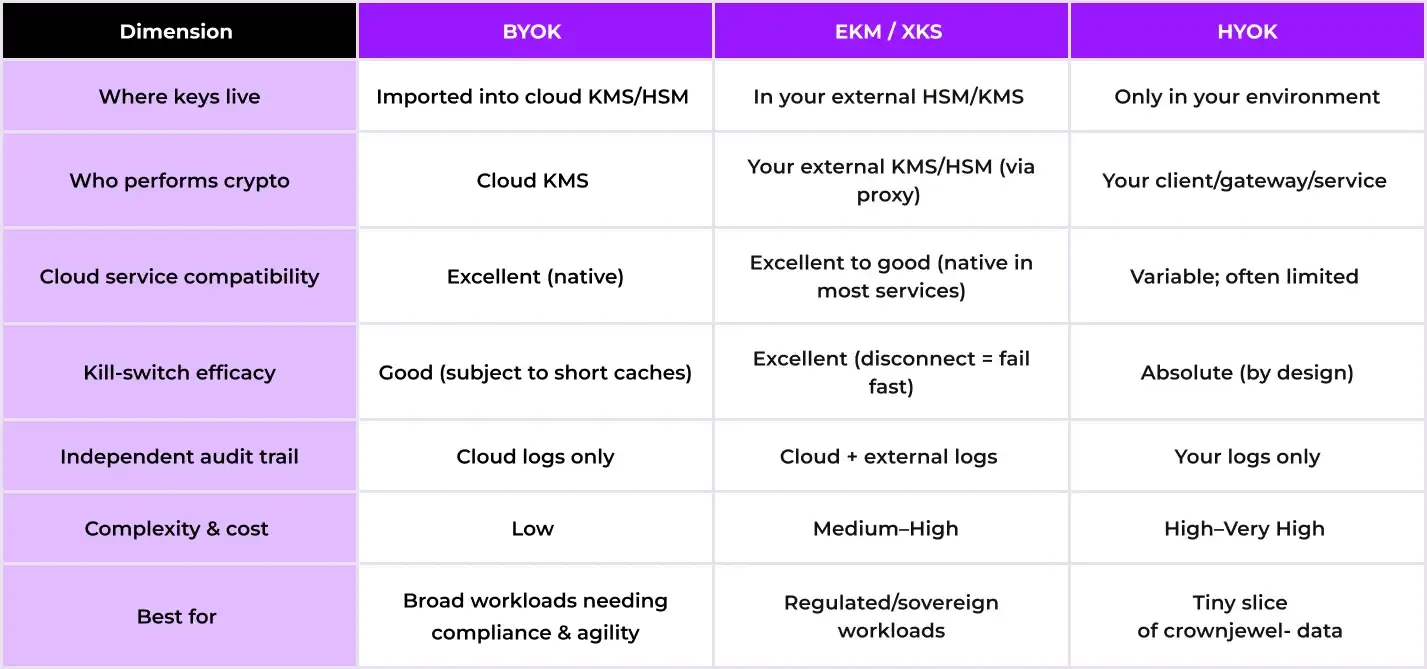
Compliance takeaway: the harsher the requirement for exclusive control, the further you move BYOK → EKM → HYOK, and the more process and infrastructure discipline you must own.
Security & Control: What Really Changes
Key exposure & trust.
- BYOK: You avoid provider generated‑ randomness/backdoors, but once imported you trust the provider’s KMS boundary and processes.
- EKM: Keys never cross the boundary; compromising the cloud alone isn’t enough—an attacker must also breach your external KMS/HSM.
- HYOK: The cloud has no path to plaintext. Only your environment can be decrypted.
Revocation & “Killswitch”
- BYOK: Disable/delete in KMS; effective, but short-term cache windows may delay.
- EKM: Flip the switch on your side (disconnect or disable). New decrypts fail fast.
- HYOK: Access is impossible without your participation in design.
Operational burden.
- BYOK: Light; mostly procedural governance and occasional rotations.
- EKM: Moderate to heavy; HSM clusters, HA, latency, monitoring, credential hygiene.
- HYOK: Heavy; app changes, UX impacts, gateway scaling, key distribution, user support.
Key Rotation & Lifecycle (What Changes Per Model)
BYOK. You trigger rotation by importing new material (often as a new key version) and transitioning services. Many teams adopt a “rotate‑andleave” approach. New writes use the new key; old data re-encrypts opportunistically unless a forced rewrap is required.
EKM/XKS. Rotation happens in your external KMS/HSM and must be coordinated with the cloud’s key reference. Plan for dual running old/new versions, clean handover windows, and credential rotation between cloud KMS and your proxy without downtime.
HYOK. Rotation is entirely your show. Use envelope encryption so you can rewrap DEKs with a new master rather than re-encrypting terabytes of data. Log lifecycle events (create/activate/retire/destroy) for audit.
Auditing & Monitoring: Where Your Evidence Lives
- BYOK: Cloud audit logs (KMS operations via CloudTrail/Monitor/Cloud Audit Logs). Integrate to SIEM, alert on anomalies.
- EKM/XKS: Two vantage points: cloud logs and your external HSM/KMS logs. Reconcile them; use the external plane to enforce real time policy (time of day, purpose-based requests) and to satisfy independent audit requirements.
- HYOK: The cloud can’t help you here. Instrument your client, gateway, or key broker to log to every decrypt. If decrypts happen only through a central path, great you have a single choke point to monitor.
Practical Scenarios & Reasoned Choices
Global Retailer — Analytics Platform → BYOK.
Needs strong protection and compliance without sacrificing warehouse/BI features. BYOK provides provenance, easy integration, and acceptable revocation of semantics. Annual rotations; SIEM watches KMS decrypt spikes.
Multinational Bank — Core Ledger → EKM/XKS.
EU sovereignty and risk posture demand external custody. Keys in on-prem HSMs via XKS; independent logs; rapid Killswitch. Accepts small latency hits and higher OpEx for the sensitive tier only.
Government Agency — Classified Docs → HYOK (Selective). On-prem‑ RMS/HSM encrypts “Top Secret” docs; cloud stores opaque blobs. Users accept limited features (no web preview/search) in exchange for maximum secrecy. Everything else uses BYOK for productivity.
Healthcare SaaS — Tenant Owned‑ Keys → EKM/HYOK Hybrid. Each enterprise customer brings a key; the app uses envelope encryption with external key lookups per tenant. Differentiator for sales; engineering invests in caching, retries, and pertenant‑ key lifecycle UI.
Decision Guide (Narrative)
- If you need broad cloud functionality with credible customer control, start with BYOK. It’s an operational sweet spot.
- If your regulator or legal counsel insists on exclusive key custody and independent auditability, push EKM/XKS for the specific workloads in scope.
- If the data category is truly zero trust toward the provider (national security, critical payments root keys, highly sensitive PII with statutory constraints), design a HYOK track accepting feature loss and higher TCO and limit it to that narrow slice.
Most mature programs land on a tiered model: BYOK as the default, EKM/XKS for regulated hotspots, and HYOK for the crown jewels.
Closing Thoughts
Choosing a key strategy is ultimately about deciding where to place trust and how to verify it:
BYOK: Trust the cloud’s cryptographic boundary but make the key yours.
EKM/XKS: trust the cloud services but keep the keys under your own lock and add an independent audit/control plane.
HYOK: minimize trust in the cloud entirely encrypt your terms and accept the operational consequences.
In 2026, the ecosystem is mature enough that you don’t have to control your workloads to gain strong key control. Pick the model that aligns with your risk, your regulators, and your team’s operational bandwidth and be prepared to mix models across data sensitivity tiers. That’s the playbook high trust organizations are running, and it works.
Quick Reference Comparison Table