Hardware Security Module (HSM) Challenges You Need to Keep in Mind

Hardware security modules (HSMs) have long been considered the pinnacle of cryptographic security. They give you a dedicated, tamper-resistant environment to generate, store and use cryptographic keys, which is mandatory when data confidentiality and integrity are paramount—think banking, healthcare or government. In fact, HSMs are often a compliance requirement as much as they are a security best practice.
But deploying an HSM isn’t as simple as buying a box and plugging it in the technology brings its own complexities and limitations. Some are obvious, while others become apparent only after years of operation. In truth, the HSM challenges organizations face today are shifting as the security landscape evolves.
This is what happens when legacy devices are asked to integrate with modern, cloud-first infrastructures. Cryptographic workloads are growing heavier, and on the horizon looms the disruptive potential of post-quantum cryptography (PQC).
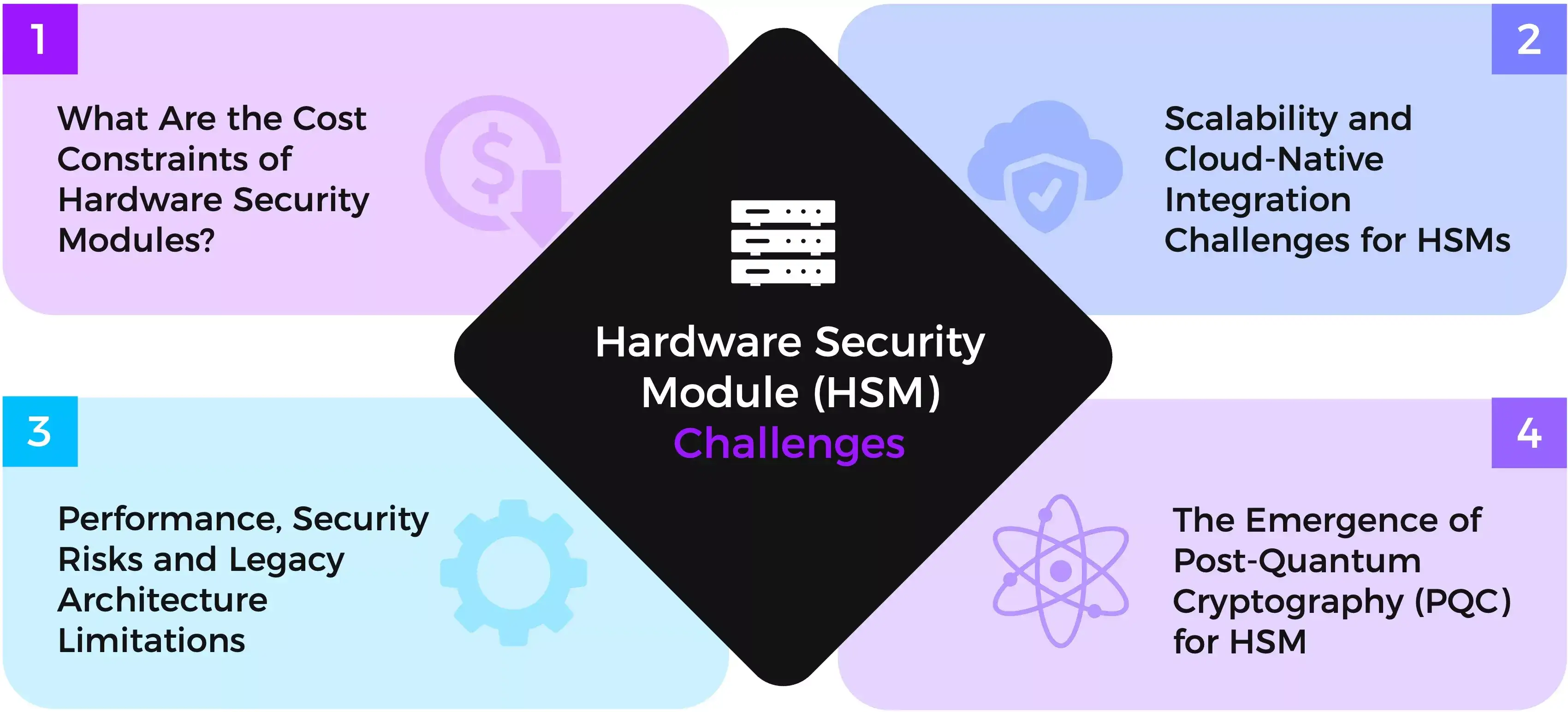
In this article, we’ll break down some of the most common hardware security module challenges that teams encounter, such as:
- Relatively high costs and getting the most from HSM investments
- Scalability and integrating with cloud environments like AWS, Azure or GCP
- The performance constraints and security liabilities of aging architectures
- Preparing for the post-quantum computing era
We’ll also share examples from the field and suggest practical steps to get ahead of these issues.
HSM Challenge 1: What Are the Cost Constraints of Hardware Security Modules?
Ask any CISO or CTO what gives them pause about HSM projects, and “cost” is almost always near the top of the list. Quality HSM appliances, especially those certified to FIPS 140-2 Level 3 or higher, don’t come cheap. And the purchase price can be just the beginning when you add in licensing fees, maintenance contracts, backup devices, and the specialized staff needed to operate it all.
For smaller organizations or those with tight budgets, these upfront and ongoing costs can be prohibitive. But even in larger enterprises, it’s not uncommon for HSM capacity to go underused. A device purchased to handle peak cryptographic load might spend most of its time operating at a fraction of its potential, which is the same as leaving money on the table.
There’s also a challenge with legacy constraints, which could lead to even more costs. Older HSMs often have rigid, physical partitions for separating workloads. While secure, this architecture can limit flexibility and require multiple devices for what could otherwise be handled virtually. Further, if you want to integrate older HSMs with newer applications or services running in the cloud, you’ll likely need custom development or middleware.
Anecdotally, an average enterprise might use five or more different key management systems, which only increases operational complexity and makes it harder to enforce consistent security policies across the organization.
HSM Challenge 2: Scalability and Cloud-Native Integration Challenges for HSMs
As workloads continue to move to the cloud, scaling a hardware-bound security model becomes tricky. Traditional HSMs are designed for on-premises environments where capacity can be tightly controlled. But in a hybrid or multi-cloud setup, this changes. For example, what if you have applications running in multiple regions, with each needing low-latency access to encryption keys?
The major cloud providers have stepped in with their own HSM-based services, including AWS CloudHSM, Azure Managed HSM, and Google Cloud HSM. While these can give you some elasticity and convenience, you should also understand the trade-offs. Relying on these services surrenders a level of visibility and control, including direct access to logs or the ability to dictate key replication policies. Jurisdictional issues can also arise if the service operates in a country with different privacy laws than your own.
The result? Organizations sometimes find themselves running both on-prem HSMs and cloud HSMs, each with its own policies, interfaces and audit requirements. Without careful planning, this hybrid model can inadvertently trigger key sprawl, inconsistent controls, and a much wider attack surface.
HSM Challenge 3: Performance, Security Risks and Legacy Architecture Limitations
Performance is another challenge for hardware security module deployments, especially as cryptographic requirements evolve. Key sizes are growing, algorithms are becoming more computationally intensive, and regulatory organizations are mandating stronger encryption, all of which in turn increases the workload on HSMs.
On a smaller level, think of how slow and antiquated a 10-year-old laptop “feels” compared to today’s newer models. Similarly, legacy devices may not have the processing headroom to handle your organization’s demands without adding latency. In high-volume environments, that delay can cascade and slow down business-critical processes. This becomes particularly noticeable when organizations handle large amounts of recorded media and need to process or convert files efficiently—for example, when using tools to screen recording to mp3 for easier storage, sharing, or audio analysis.
Security risks also change over time. HSMs are meant to be tamper-resistant, but no system is perfect. Flaws in firmware, side-channel vulnerabilities, and poor key management practices can all undermine the benefits of HSMs, even in what appears to be a secure situation. For example, various research has demonstrated timing attacks that can extract private keys from certain hardware modules under specific conditions.
Finally, the “black box” nature of HSMs—which, in theory, is a security strength—can also be a limitation. Debugging performance issues or integrating new capabilities often requires a vendor to intervene, which slows projects down even more and adds cost.
HSM Challenge 4: The Emergence of Post-Quantum Cryptography (PQC) for HSM
While today’s HSMs are good at managing classical algorithms like RSA, ECC, and AES, the looming rise of quantum computing threatens to shake these foundations to the core. Experts warn that once sufficiently powerful quantum computers become available, today’s widely used public-key algorithms could be broken in a matter of days or even hours.
It may sound futuristic, but it’s not just a theoretical exercise. The U.S. National Institute of Standards and Technology (NIST) has already selected its first batch of post-quantum algorithms, with more to follow. The transition to PQC will be one of the most significant cryptographic migrations in decades, and HSMs will be central to that effort.
The challenge? PQC algorithms tend to have larger key sizes and require significantly more processing power than current algorithms. Older HSM hardware may struggle to support them without performance degradation. Middleware, APIs, and application code will also need to be updated to handle new key formats and cryptographic operations.
This is where early preparation matters. Ultimately, the takeaway is this: waiting until PQC is a live threat will only make the migration more costly and disruptive. Starting now gives you the flexibility to phase changes in gradually, and it will undoubtedly cost less in the long run.
Turn HSM Challenges into Opportunities
HSMs remain one of the most effective and trusted tools in a security architect’s playbook, but they have their limitations. Whether it’s the high upfront investment, difficulty scaling into cloud environments, performance demands of modern encryption, or the looming post-quantum migration, these devices require thoughtful planning and ongoing management to deliver full value.
The organizations that succeed will be those that view HSMs as evolving components of a larger overarching security strategy. That means building scalability, preparing algorithmic change, and ensuring visibility across both on-prem and cloud environments.
If you’re looking to get ahead of these HSM challenges—including the quantum threat—Fortanix can help. Request a demo to see how our Key Insight and Data Security Manager solutions can modernize your key management and position your organization for the post-quantum era.