How to Maintain GDPR Compliance While Securely Deploying On-Prem Models

This summer, the European Data Protection Board ended a long-running argument the AI industry had been having with regulators.
The adoption of Guidelines 03/2026 on Web Scraping in the Context of Generative AI confirmed that GDPR applies in full to AI at every stage, including data collection, model training and inference, with no exceptions or assumption that publicly available data is freely usable [source]. The board also adopted demanding anonymization guidelines that it says, in practice, "few AI systems meet.”
For organizations deploying AI on personal data, the regulatory expectations are strict, but at least they’re clear. Moving AI workloads on-premises to gain control is the right instinct for most businesses that are doing so, but it only solves part of the problem.
The On-Premises Migration Is Real
The move toward on-premises AI is happening. Enterprise spending on AI compute and storage hardware jumped 166% year-to-year in the second quarter of 2025, according to IDC [source], signaling a race to build infrastructure.
The multinational investment bank Goldman Sachs, for example, built a private AI infrastructure stack that runs agentic tools across its large developer workforce, citing regulations and competitive sensitivity as reasons it was necessary.
Meanwhile, Siemens says it deploys AI directly on factory floors because latency, security and continuity make depending on the cloud unacceptable.
It makes sense: if data never leaves your organization's infrastructure, a significant part of GDPR exposure disappears. But on-premises deployment doesn't eliminate the part of GDPR that matters most for AI: protecting personal data during inference.
There’s a Gap On-Premises Deployment Doesn't Close
Here's what happens when an on-premises AI model processes a query containing personal data.
The model has to read the data to use it, so it’s decrypted and loaded into memory in plaintext on the hosting hardware. While there (with the model actively running), that data is visible at the infrastructure layer to the host operating system and anyone with the correct system privileges.
On-premises infrastructure doesn't change what the hardware exposes during computation. In other words, an organization that has moved AI on-premises to satisfy GDPR's data transfer requirements could still have personal data visible in plaintext in GPU memory during inference. This is known as the data-in-use gap.
GDPR's Article 32 requires appropriate technical and organizational measures to protect personal data during processing [source]. The EDPB's recently adopted guidelines make clear that "processing" includes inference, when the model is actively computing on personal data.
A compliance program that accounts for data transfer and data residency but not the data-in-use gap leaves itself vulnerable to what supervisory authorities are increasingly looking for.
There’s still another issue: organizations that comply with GDPR also need to be able to demonstrate compliance. For on-premises AI inference, demonstrating that personal data was protected during processing (not just before and after) requires evidence that traditional infrastructure doesn’t provide.
Protecting Personal Data During Inference
Closing the data-in-use gap means you need to protect what happens inside the model during active computation, and it’s exactly what Confidential Computing does.
Trusted execution environments [TEEs] are hardware-enforced, physically isolated regions on a processor where code and data are processed, with memory encryption maintained by the silicon itself. Inside a TEE, personal data being processed by an AI model stays encrypted throughout inference.
Since the isolation is a property of the hardware, there is no software configuration that could be changed by someone with the right credentials.
For inference, protection must extend to the GPU, where personal data is processed by the model. CPU-only TEE protection covers the orchestration layer but leaves the inference operation outside the verified boundary.
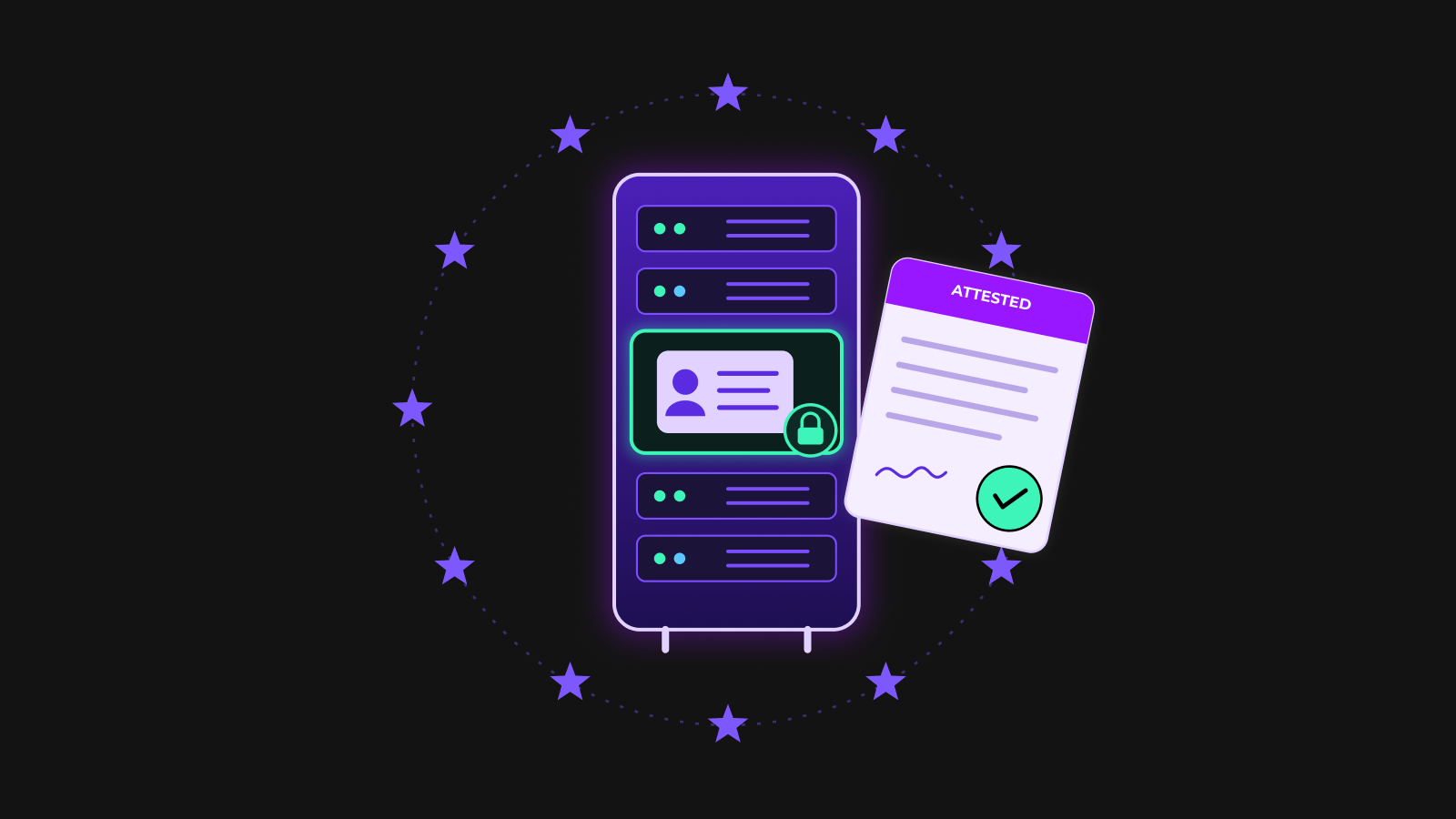
The other important component is cryptographic attestation, which provides the compliance evidence that GDPR Article 5(2) requires. Before any personal data is released into an inference environment, the hardware generates a signed report that proves its identity, firmware state, and the exact software running inside the TEE.
That report is signed by a key embedded in the processor, and it cannot be forged at the software level. All of this creates a continuously generated, hardware-signed, and tamper-evident record of what was running and in what verified state at the moment personal data was processed.
When the auditors come calling, this evidence meets a much stronger standard than access logs that an administrator could potentially modify.
Fortanix Confidential AI Addresses the On-Premises GDPR Challenge
Fortanix Confidential AI brings together the components on-premises AI deployments need to close the data-in-use gap and produce the compliance evidence required by GDPR.
Fortanix Confidential Computing Manager performs composite attestation across both CPU and GPU environments simultaneously. If any component of the hardware or software stack doesn't match the expected verified state, the attestation will fail, and the workload won't move forward.
Fortanix Data Security Manager enforces attestation-gated key release, meaning encryption keys protecting personal data and model weights are released only to environments that have passed composite attestation.
Keys protecting an organization's on-premises AI data are never accessible outside a verified TEE, because there are no keys outside the enclave to hand over.
The attestation logs produced by Fortanix are securely signed by the hardware and verify the state of the execution environment during each inference operation.
This is strong evidence that meets GDPR standards; when organizations need to show that personal data was safeguarded during AI processing, the attestation records are much more valuable than policy documents and access logs.
Compliance Built Into the Foundation
The perfect storm of the EDPB's guidelines, the EU AI Act, and stricter GDPR enforcement around AI points in the same direction: regulators expect organizations to protect personal data during AI processing and to produce evidence of that protection.
Moving AI workloads on-premises is the right first step because it eliminates cross-border transfer risks and gives organizations direct control over where their data resides.
But GDPR compliance for on-premises AI extends to the moment the model touches personal data; the only architecture that protects that moment and produces verifiable proof is built on hardware-enforced Confidential Computing.
Organizations building that foundation now, as regulatory frameworks evolve, will be able to say with evidence that their on-premises AI operates exactly as GDPR requires.