How to Prepare for Post-Quantum Cryptography

NIST Director Arvind Raman recently gave a clear message at the Quantum World Congress: Post-quantum cryptography has left the lab. Raman said NIST-based PQC standards are "being implemented at scale as we speak," citing examples including Google's use of ML-KEM in Chrome and PQC protections that IBM and Amazon have rolled into parts of their infrastructure and cloud offerings.
He says 60 companies are working through NIST's National Cybersecurity Center of Excellence to scale adoption across critical sectors.
In most enterprises, the picture looks a bit different. Security teams understand the quantum threat, but many still can't answer a basic question like where their cryptography actually lives.
If the world's largest tech companies are already migrating, how much longer can everyone else afford to wait?
The Quantum Threat is Already a Present-Day Problem
Cryptographically relevant quantum computers don't exist yet. The problem is that attackers don't need one to get started.
In a "harvest now, decrypt later" attack, crooks can steal encrypted data now and store it until quantum hardware can break the encryption. Everything from financial records and patient data to intellectual property and classified material could keep their value for years. Anything protected by RSA or elliptic curve cryptography will become readable as soon as a powerful enough quantum machine comes online.
The regulatory clock is also running, and governments have moved past general warnings. In the U.S., Executive Order 14412, signed June 22, pulled key migration deadlines for high-value and high-impact federal systems forward from 2035 to 2030 and 2031. Other countries have published their own timelines, typically an early deadline for critical systems and a final cutoff around 2035.
Here are some key PQC readiness deadlines by region:
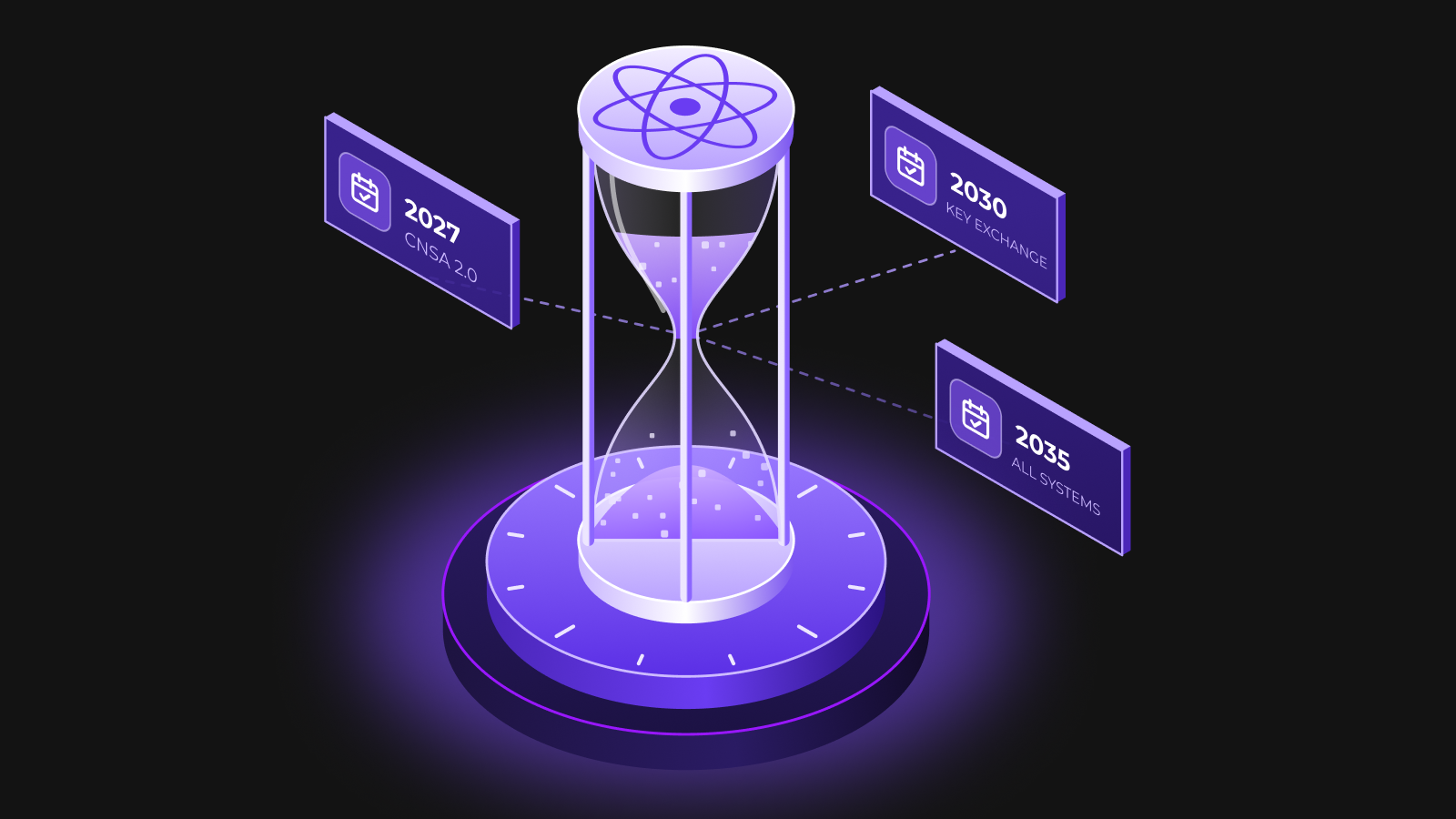
- U.S.: Federal high-value assets and systems must use PQC for key establishment by Dec. 31, 2030, and for digital signatures by Dec. 31, 2031. All remaining systems must migrate by 2035. In addition, the NSA's CNSA 2.0 requires new national security system acquisitions to support quantum-resistant algorithms starting in 2027.
- Canada: High-priority federal systems must complete migration by the end of 2031. All remaining non-classified systems have until the end of 2035.
- EU: High-risk and critical infrastructure must move to PQC by the end of 2030. Member states should complete the transition for as many systems as feasible by the end of 2035.
- UK: The NCSC expects organizations to finish discovery and an initial plan by 2028, complete the highest-priority migrations by 2031 and finish migrating all systems, services and products by 2035.
- Middle East: The UAE's National Encryption Policy requires government agencies to submit formal PQC transition plans, but there isn't yet a migration deadline. Saudi Arabia's NCS-2:2025 standard requires cryptographic systems to support NIST's PQC algorithms, also without a migration date.
- Australia: Organizations are to begin transitioning critical systems by the end of 2028. The government recommends that they stop using traditional asymmetric cryptography, including RSA and ECDH, by the end of 2030. The ASD also discourages hybrid schemes as a long-term approach.
- APAC: Timelines vary by country. Singapore's guidance for critical infrastructure calls for new systems to be quantum-safe from Jan. 1, 2028, and for migration to finish by Dec. 31, 2031. Meanwhile, Japan has set 2035 as the deadline for all government agencies. South Korea is aiming for broad industry adoption by 2035, with critical sectors such as energy and healthcare piloting first.
- South America: No Latin American country has set a PQC deadline as of September 2026. Brazil added ML-KEM and ML-DSA to its certificate standard in January 2026, but there is no hard migration date.
- Africa: No country has published a PQC deadline; South Africa and Nigeria have started policy frameworks, but few other African institutions have published migration strategies.
The timelines vary, but for multinational organizations, the earliest deadline in any market they operate in is the "real" one. For example, an Australian arm of a Japanese company will need to answer to the ASD's 2030 date, not Japan's 2035 target. Companies working in regions without local mandates will still feel the pressure through vendors, federal contracts and foreign partners.
Those dates feel distant, but most organizations need three to five years to become completely PQC-ready, and several obstacles slow them down. Few have a central cryptographic inventory, meaning keys and certificates are scattered across systems. Older applications depend on undocumented cryptographic libraries that may not support new algorithms.
Many hardware security modules predate PQC standards entirely. TLS, VPNs, PKI, code signing and DevOps pipelines all rely on cryptography, so a change in one place can break something along the line.
What It Takes to Prepare for Post-Quantum Cryptography
Organizations that handle this transition well follow a consistent four-step sequence.
1. Discovery. You can't migrate what you can't see. That means building a complete inventory of algorithms, keys, certificates, and every system that depends on them.
2. Assessment. Systems carry different levels of risk. Data with a long shelf life and systems tied to critical operations should move first, and data classification helps separate urgent work from routine upgrades.
3. Planning. NIST finalized its first three PQC standards in August 2024: FIPS 203 (ML-KEM) for key establishment, with FIPS 204 (ML-DSA) and FIPS 205 (SLH-DSA) for digital signatures. In March 2025, NIST selected HQC as a backup key encapsulation algorithm. Many organizations will run hybrid deployments that pair classical and post-quantum algorithms during the transition. Hybrid modes that combine an approved post-quantum algorithm with a classical one fall outside the proposed 2035 disallowance, which supports a phased migration. Testing algorithms in a controlled environment before production rollout keeps surprises to a minimum.
4. Crypto-agility. NIST is still adding algorithms, and the standards will continue to change. Teams that hard-code their current choices into applications will face the same painful migration again in a few years. Crypto-agility gives you the ability to change algorithms, rotate keys and update policies without rewriting code or replacing hardware.
How Fortanix Helps Organizations Make the Shift
Fortanix structures PQC migration around the four aforementioned steps: discover, assess, plan and stay crypto-agile.
Fortanix Key Insight covers the first two. It continuously discovers cryptographic assets across multicloud, on-premises and third-party environments, then maps each key to the services and resources that use it. Key Insight flags weak algorithms, missing rotation policies and unencrypted resources, and it pinpoints which assets will be vulnerable to quantum attacks.
Most discovery tools focus solely on visibility, but Key Insight also helps teams with remediation, allowing them to fix problems from the same platform where they were found.
For planning, the Fortanix PQC Lab provides sample libraries and test environments where teams can evaluate quantum-safe algorithms before deployment. A central dashboard tracks readiness across environments, and you can integrate with ServiceNow and Jira to work a migration roadmap into your existing IT operations.
Fortanix Data Security Manager (DSM) is the anchor for a long-term transition, combining a FIPS-certified HSM and key management service in one platform. It supports algorithms that comply with NIST and CNSA 2.0 standards and integrates with databases, PKIs and signing workflows on-premises and in the cloud. Because DSM is software-defined and built on confidential computing, organizations can update algorithms and policies without hardware upgrades or application rewrites.
When NIST publishes its next standard, your team will only need to update a policy instead of launching another multiyear project.
Don't Wait for the Deadline
NIST's first standards are final, major vendors are deploying them now, and federal timelines are set. What's left open is how quickly individual organizations act.
To prepare for PQC, it’s best to start with visibility. Prioritize risk levels, test hybrid approaches before you need them, and build the agility needed to adapt if and when standards evolve. Organizations that begin now will migrate on their own schedule, not an attacker's.
Quantum computers will undoubtedly break today's encryption. What matters most is whether your most sensitive data will still be worth stealing when they do.
Learn how Fortanix can help you assess your PQC readiness.