Is Quantum Encryption Going to Break in the Future?

Governments around the world are being transparent about how unprepared they are for post-quantum cryptography (PQC).
In early October 2026, the U.S. Government Accountability Office (GAO) released a report reviewing the 24 federal agencies covered by the Chief Financial Officer Act to see how well they’re preparing for quantum computers capable of breaking current-gen encryption.
Spoiler alert: it’s not going well. In fact, not one agency has fully addressed the three preparatory practices the GAO evaluated [source].
The next day, Europol published its own report warning that some governments are reportedly already stealing encrypted data to unlock once quantum machines mature [source]. In fact, the EU has an accelerated timeline, asking member states to start cryptographic inventories and national transition plans by Dec. 31, 2026.
Meanwhile, in Asia-Pacific, the Cyber Security Agency of Singapore (CSA) asks critical infrastructure owners to submit quantum-safe migration plans by March 31, 2027. And the Australian Signals Directorate (ASD) has set 2030 as its target for retiring traditional public-key cryptography [source].
Deadlines are approaching across the globe, yet many agencies with large cybersecurity budgets and years of guidance still haven’t finished identifying the cryptography they use. If governments are this far behind, most private companies likely are too.
That leads to a question security leaders around the world keep asking: Is quantum encryption going to break? Much of the encryption protecting data will, at some point. And the window to prepare is shorter than most assume.
What do Quantum Computers Do to Encryption?
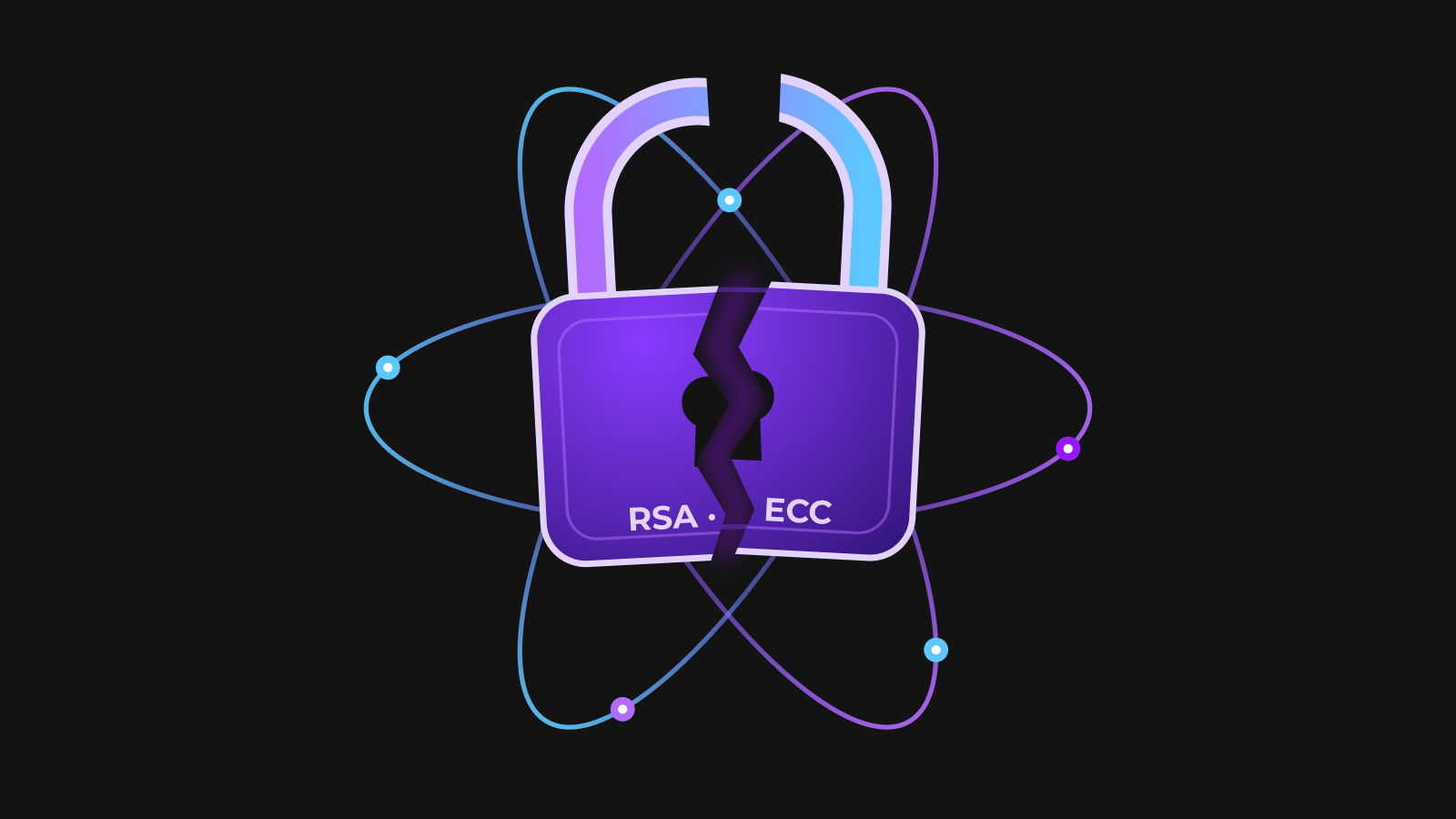
When people talk about quantum encryption breaking, they’re usually talking about the public-key cryptography that secures just about everything online. RSA and elliptical curve cryptography (ECC) protect web traffic, VP connections, software updates, digital signatures and key exchanges for encrypted sessions.
The security relies on hard math problems that classical computers can’t solve quickly, such as factoring very large numbers.
Quantum computers change that. In the mid-1990s, mathematician Peter Shor published an algorithm (Shor’s algorithm) showing that a sufficiently powerful quantum computer could solve those problems efficiently. A cryptographically relevant quantum computer hasn’t been built yet, but most industry experts believe that one could arrive in the 2030s.
Symmetric encryption such as AES holds up better against quantum attacks, but the real exposure risk lies with the public-key systems that run through nearly every enterprise environment.
The Quantum Threat is Already Here
While quantum machines don’t yet exist, they can still put your data at risk today. Attackers can steal encrypted traffic now, store it and decrypt it once relevant quantum computers become available. Both the GAO and Europol flagged this “harvest now, decrypt later” risk, and Europol noted that some governments are reportedly already carrying it out.
A major factor here is how long the data needs to stay confidential.
For example, health records, intellectual property, government communications, customer identities and financial data could all hold value for 10 years or more. If that type of data is already moving over networks currently protected by RSA or ECC, it’s already exposed to a future decryption attack.
If this is true, why are organizations moving so slowly? In the government’s case, the GAO points to three specific gaps: a shortage of cryptography expertise, no formal processes to build cryptographic inventories or identify transition funding, and no plans to test quantum-resistant algorithms.
The inventory gap makes sense; most enterprises don’t know where all their cryptographic keys live, which algorithms protect which data, or which applications depend on vulnerable cryptography. We like to say “you can’t migrate what you can’t see,” which in this case refers to keys spread across cloud providers, on-premises databases, hardware security modules (HSMs) and code libraries.
Here’s How Organizations Can Prepare
The answer to all this is a new generation of PQC algorithms. The National Institute of Standards and Technology (NIST) finalized its first three PQC standards in August 2024: FIPS 203 (ML-KEM) for key establishment, and FIPS 204 (ML-DSA) and FIPS 205 (SLH-DSA) for digital signatures. In March 2025, NIST named HQC a backup key-establishment algorithm.
Other regions have similar timelines. The EU roadmap calls for high-risk use cases to move to quantum-safe cryptography by the end of 2030, the U.K.’s National Cyber Security Centre (NCSC) targets full migration by 2035, and Australia’s ASD wants traditional public-key algorithms retired by 2030.
The organization has also proposed deprecating RSA and ECC after 2030 and disallowing them after 2035, aligning with the federal goal of moving government systems to quantum-resistant cryptography by 2035.
Successfully transitioning to PQC happens in four key steps:
- Discover every cryptographic asset your organization has, including keys, certificates, algorithms and the applications that use them.
- Assess which of those assets rely on quantum-vulnerable algorithms, then prioritize based on the level of data sensitivity and how long the data must stay protected.
- Remediate by migrating to PQC algorithms using a hybrid approach that pairs classical and post-quantum algorithms during the transition period.
- Build crypto-agility, or the ability to withstand algorithm changes without rebuilding applications or infrastructure.
PQC standards will continue to evolve, and NIST is still evaluating additional algorithms. If you hard-code cryptography into individual applications now, you’re likely looking at another time-consuming migration in the future.
Fortanix Helps You Become Quantum-Ready
Fortanix addresses visibility, planning and execution, which are the three areas where the GAO found agencies falling short.
Fortanix Key Insight handles the inventory problem by automatically discovering encryption keys and the data services that use them across cloud providers and on-premises environments. It then assesses your overall posture and identifies which keys need to move to quantum-resistant algorithms.
There’s also a handy PQC Central feature that gives security teams a view dedicated to quantum exposure, helping them decide which are the highest-risk assets to tackle first.
Meanwhile, Fortanix Data Security Manager (DSM) handles remediation, bringing key management, encryption, tokenization and secrets management together in a single platform.
It includes support for the full Commercial National Security Algorithm Suite 2.0 (CNSA 2.0), including the post-quantum standards NIST has finalized. Since everything is centralized, teams can quickly rotate keys and migrate algorithms without rewriting the apps that depend on them.
DSM runs on Confidential Computing, a Fortanix-pioneered technology that protects data (in this case, keys and cryptographic operations) inside hardware-based trusted execution environments (TEEs). Federal agencies and enterprises are already using it as an alternative to legacy HSMs, which weren’t made for multicloud scale or post-quantum algorithms.
Together, these tools give organizations a complete picture of their cryptography so they can create an executable migration plan.
Waiting Around For Deadlines Will Mean You’re Already Too Late
Quantum computers will break today’s encryption, but the open question is when. But will quantum encryption itself break eventually? Because it’s physics-based, the easy answer is “no,” but quantum encryption could still fail if implementation flaws or limited infrastructure get in the way.
As it stands, the GAO’s own findings show that even well-funded, heavily regulated organizations haven’t finished identifying their vulnerable cryptography. Organizations that start now can inventory their assets, prioritize the most sensitive data and build crypto-agility to adapt as standards evolve.
Those that wait will be forced to migrate under deadline pressure, with years of data likely already exposed.
The main goal now should be to find your vulnerable cryptography before an attacker does. Learn how Fortanix Key Insight and Data Security Manager can help you kick off your post-quantum readiness efforts today.