A Practical Roadmap for Post-Quantum Cryptography (PQC) Migration

With post-quantum cryptography mandates on the horizon, governments around the world are spelling out how far they have to go before they’re ready for PQC migration.
In early October, the Dutch cabinet sent parliament a government-wide quantum strategy with a dated PQC timeline, calling for cryptography policies by the end of 2026, draft migration plans by the end of 2027 and migration of high-risk systems by 2030 [source].
The next day, the U.S. Government Accountability Office (GAO) publicly released its post-quantum readiness audit of the 24 federal agencies covered by the CFO Act. All of them came up short, and none had fully implemented the required preparatory practices.
In fact, 23 of the 24 hadn’t even run any operational PQC testing.
The deadlines vary by region. U.S. federal high-value systems must use PQC for key establishment by the end of 2030, and every other system must migrate by 2035. The NSA’s CNSA 2.0 requires new national security systems to support quantum-resistant algorithms by 2027.
The EU has set 2030 as the date for high-risk and critical infrastructure, and member states are building national plans around it. Along with the Netherlands, Belgium has told telecom operators to migrate their most critical systems by 2030 [source].
Canada, the UK and Singapore have set 2031 for priority systems. Australia recommends that organizations stop using RSA and ECDH by the end of 2030; Japan and South Korea want the same by 2035.
Essentially, regulators want the most sensitive systems to finish post-quantum cryptography migration within five years and everything else within nine. It may sound like there is still plenty of time, but most organizations need three to five years to complete a PQC migration, and that’s assuming they already know where all of their cryptographic assets live.
Most don’t.
PQC Migration Is Harder Than It Looks
Cryptography touches every layer of the enterprise, but few organizations have a complete map. It’s nobody’s fault; teams incrementally configured cryptography over a period of years, and team members (and their knowledge) inevitably left for new opportunities.
The first challenge is getting a handle on inventory. The GAO found that 19 of the 24 agencies it audited weren’t using automated discovery tools, and some inventories didn’t include high-value assets and PKI systems. Without a full inventory, you can’t prioritize, budget, or test.
Legacy infrastructure creates more difficulty. Older applications often rely on hard-coded cryptographic libraries, and most traditional hardware security modules (HSMs) don’t support NIST’s PQC standards.
PQC keys and signatures are also much larger, which can strain systems that were built and optimized for current-gen algorithms.
Attackers don’t care, of course. They can still capture encrypted traffic now and hold onto it until a capable quantum computer can break it. With the deadlines where they are, any data that must stay confidential into the 2030s is already at risk.
Building a PQC Migration Roadmap
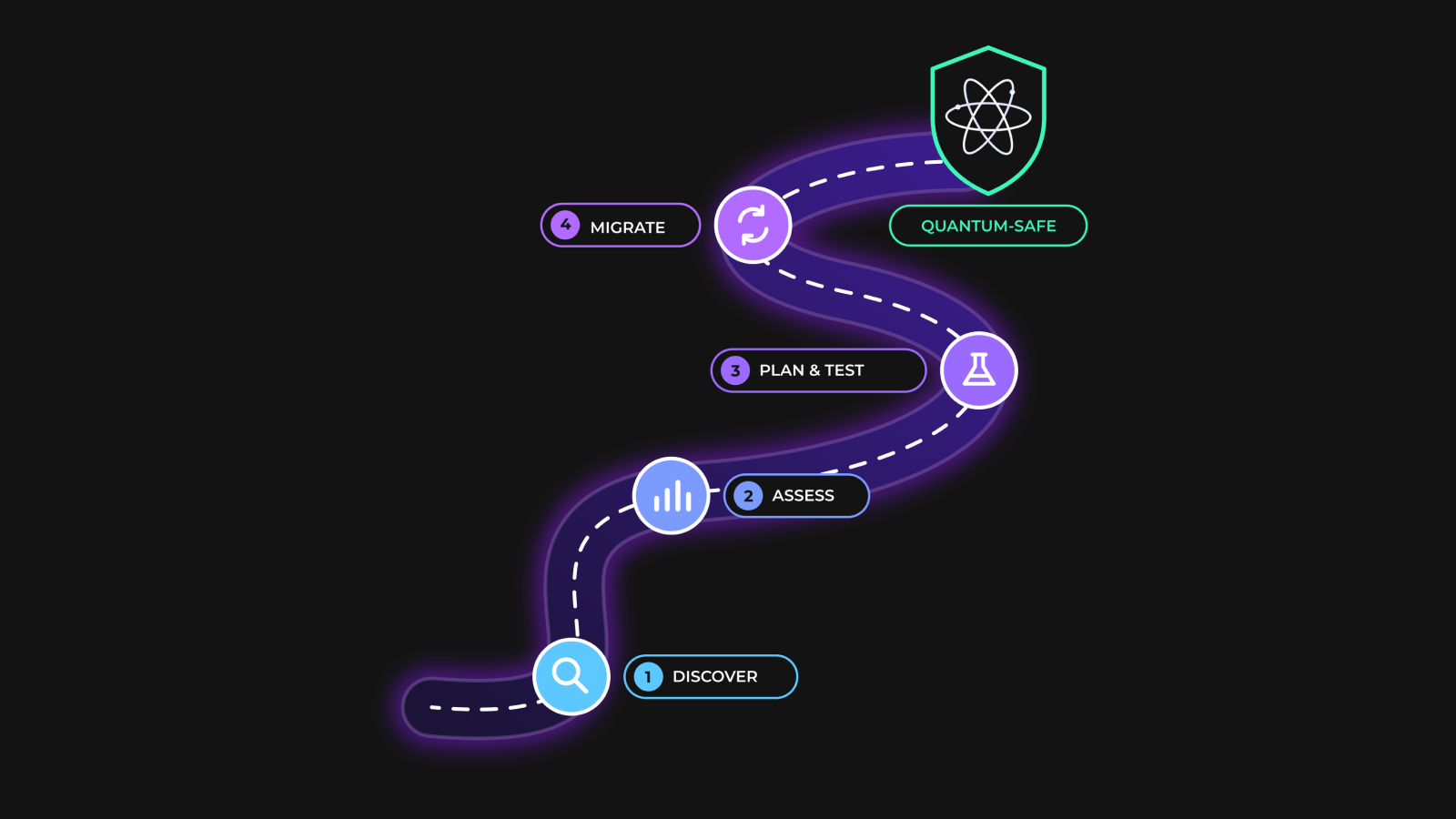
There are four primary stages in a workable post-quantum cryptography migration roadmap:
1. Discover. Build and continuously update an inventory of cryptographic assets across environments, including cloud, on-premises, containers, source code and third-party services. Track which algorithms are in use, where keys live and which applications use them. Automating this process is a must because conditions change quickly.
2. Assess and prioritize. Rank your assets by data sensitivity, how long the data must remain protected and whether the system is subject to a regulatory deadline. Focus on long-lived secrets and higher-value systems first.
3. Plan and test. Once you know the priorities, turn them into a sequenced plan with defined owners, budgets and deadlines. Test NIST’s standardized algorithms (ML-KEM for key establishment and ML-DSA for digital signatures) in non-production environments so you can gauge performance and compatibility. Make sure your roadmap aligns with those of your vendors.
4. Migrate with crypto-agility. Centralize key management so algorithm changes don’t require code rewrites. Many organizations find it beneficial to take a hybrid approach, pairing classical and PQC algorithms during a defined transition period (it should be noted that Australia’s guidance discourages this as a long-term approach). Design your systems so you can swap algorithms when needed, considering NIST is still adding PQC standards.
Fortanix Supports Every Stage of PQC Migration
Fortanix Armor helps teams handle discovery, assessment, planning and remediation from a single platform, creating a more cohesive experience throughout the PQC migration process.
It begins with Fortanix Key Insight, which discovers encryption keys and data services across multicloud, on-premises, and external key-source environments, as well as vendor applications. It maps keys to the services that use them and flags weak algorithms, missing rotation policies, and unencrypted resources. The PQC Central feature creates a prioritized list of quantum-vulnerable assets that teams can use to develop a concrete attack plan.
For the planning stage, Fortanix’s PQC Lab gives teams sample libraries and test environments to evaluate quantum-safe algorithms before rolling them out. You can track PQC readiness across environments via a central dashboard, and integrations with ServiceNow and Jira enable teams to incorporate the migration roadmap into existing IT workflows.
Fortanix Data Security Manager handles execution and supports NIST and CNSA 2.0-compliant algorithms. It centrally manages the full key lifecycle, allowing organizations to adopt new algorithms as standards inevitably change without redesigning applications.
The PQC Countdown is On
Governments worldwide have set PQC deadlines, with the first milestones arriving as soon as the end of this year. Major ones will follow in 2030 and 2031. The Netherlands wants every central government organization to have a cryptography policy in place within months, but the GAO audit illustrates how hard even that first step can be.
It can’t be overstated: a successful PQC migration starts with knowing what you have. You then need to rank what matters most, test before fully committing, and build in crypto-agility so you can change course when necessary.
How much of the migration window has your organization already used?
Whether you’re down a path or looking to get started, contact us to learn how Fortanix can help you build a successful PQC migration roadmap for your organization.