Why Cloud-Native Security Needs a Rethink in the Age of AI

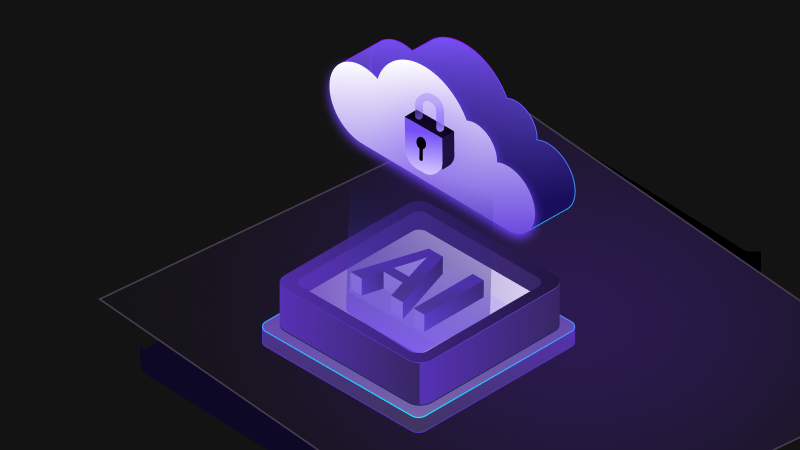
There’s no sugar-coating it: the rise of AI has exposed weaknesses in how organizations think about cloud security.
Most businesses still rely heavily on built-in cloud controls and scattered third-party tools, even as data volumes multiply and attack surfaces expand. This has caused security teams to revisit a core question: What is cloud-native security, and what does it take to protect my data in an era defined by distributed computing, rapid automation and AI-driven workloads?
In this article, we’ll break down why traditional approaches to cloud-native data protection don’t go far enough, and how organizations can evolve their strategies without adding unnecessary complexity.
Here’s a quick checklist of what you’ll learn:
- What security teams mean when they ask “What is cloud-native security?”
- Why AI and modern workloads challenge assumptions about cloud trust models
- How platform-native controls differ from unified cloud-native data protection
- What organizations should expect from next-generation cloud security tooling
- A comparison of cloud platform-native security vs. independent cloud data security
- Where quantum computing, crypto-agility and modern key management come into play
- Recommendations for moving forward
Let’s get started.
First Things First: What Is Cloud-Native Security?
Understanding what cloud-native security is starts with acknowledging that the cloud has changed the nature of trust. Instead of securing static infrastructures as we did in the early 2000s and earlier, teams now secure ephemeral, API-driven environments that scale up and down constantly. The cloud’s shared responsibility model puts the cloud providers in charge of infrastructure-level protections, but everything on top—applications, identities, workloads, keys and data—falls on the customer’s side of the equation.
Modern cloud-native security frameworks are built around these principles:
- Identity-first access and least privilege
- Zero Trust architecture, eliminating assumptions about trusted networks
- Infrastructure as code, where security controls must integrate into DevOps workflows
- Decentralized data storage and encryption, spanning multi-cloud and hybrid environments
- Automation and observability, reducing manual interventions
- Integrated key and secret management, not isolated vaults scattered across teams
If they’re not already, most enterprises will soon use multiple cloud service providers, making fragmented security and decentralized key management one of the fastest-growing risks. This fact alone has driven many organizations to rethink previously accepted data-security practices.
AI Changes the Equation for Cloud Security
The rise of AI has exposed gaps in existing data security approaches because the workloads involve distinct data-protection concerns:
- Large-scale ingestion of proprietary (and often sensitive) data
- High-throughput encryption and key usage
- Sensitive models that require protection during training and inference
- Data residency and compliance requirements that differ by region
- API-driven integration with third-party tooling
Many organizations have found that AI has pushed them beyond what their existing cloud configurations can handle. Think about it: AI model training can involve thousands of containers running parallel operations; inference workloads run globally; and sensitive embeddings or model weights circulate through storage layers not originally designed for AI data movement.
We’re living in a new era, and the paradigm has shifted. But what we know is that much of the added risk stems from gaps in data visibility and inconsistent key-management practices across clouds.
What Is Public Cloud Platform-Native Security?
When teams ask what public cloud platform-native security is, they’re typically referring to the built-in tools from providers such as AWS, Azure or Google Cloud. These include:
- Identity and Access Management (IAM)
- Logging and monitoring
- Network segmentation
- Native KMS or key vault services
- Secrets managers
- Application firewalls and DDoS controls
These tools are useful and integrate nicely into each provider’s ecosystem. But they also share predictable limitations, especially for organizations using multiple clouds or dealing with sensitive data subject to regulatory requirements.
Public cloud–native tools often struggle with consistency across clouds, including the enforcement of unified policies. Teams also need to know where sensitive data is flowing into AI pipelines while managing end-to-end key management across vendors.
Since the vendors are incentivized to keep workloads inside their own clouds, platform-native security isn’t always designed with portability or neutrality in mind. This leads to organizations layering multiple systems— think AWS KMS, Azure Key Vault, Google KMS, plus independent vaults and certificates.
Ultimately, this creates a fragmented environment that’s hard to audit and automate.
Why Cloud-Native Data Protection Needs an Update
The phrase “cloud-native data protection” originally referred to storing and encrypting data inside cloud infrastructure, but the term has expanded significantly. As AI workloads and distributed architectures grow, data protection must now include:
- Centralized key visibility across clouds
- Unified encryption policies
- Runtime protection for sensitive computation
- Confidential computing adoption
- Automation of certificate and key rotation
- Proactive detection of cryptographic weaknesses
- Separation of duties between providers and customers
There’s no getting around the fact that cryptographic consistency and transparency are foundational for secure cloud operations. Simply relying on isolated tools offered by the cloud providers isn’t enough when data moves through AI pipelines, SaaS integrations and hybrid environments.
| Platform-Native Security vs. Cloud-Native Data Protection | ||
|---|---|---|
| Feature | Platform-Native Cloud Security | Unified Cloud-Native Data Protection |
| Scope | Works only within one CSP | Consistent across multi-cloud |
| Key Management | Separate KMS per cloud | Unified key lifecycle management |
| Automation | Cloud-specific APIs | Standardized automation for all clouds |
| AI Workload Support | Limited visibility | Expanded data, model, and secrets protection |
| PQC Readiness | Vendor-dependent | Centralized crypto-agility and algorithm control |
| Compliance | Per-provider | Cross-cloud posture and auditing |
| Data Movement Visibility | Partial | End-to-end tracking and policy enforcement |
The above comparison highlights why many organizations are transitioning from cloud-native “as provided by CSPs” toward more unified, multi-platform security architectures.
The PQC Implications for Cloud-Native Security
With NIST already standardizing the first wave of algorithms, post-quantum cryptography (PQC) becomes more real every day.
With this backdrop, enterprises are evaluating how to migrate long-lived data and keys. The challenge in cloud environments is that encryption and signing operations are scattered. Keys live in CSP-native KMS systems, application-level vaults, CI/CD secrets, API gateways and more.
For cloud-native teams, PQC introduces three immediate questions:
- Which algorithms are currently in use across clouds?
- Which data flows or keys will require replacement?
- How can migrations be coordinated without breaking systems?
This is where cryptographic discovery and crypto-agility come in. The idea is to discover, map, and assess your cryptographic assets across clouds so you can become agile when it comes to PQC transition and algorithm rollout when necessary.
Again, the architectural principle holds: centralized visibility is the best way to manage a decentralized cloud.
An AI-Era Rethink Is Inevitable
The combination of cloud scale, AI workloads and cryptographic evolution has made one thing clear: cloud-native security, as traditionally defined, no longer covers enough ground. Organizations can’t afford to rely solely on platform-native controls or scattered security tooling. What’s needed is a unified strategy that recognizes data mobility, multi-cloud complexity, modern automation, and the imminent shift to PQC.
To recap:
- Cloud-native security must now account for AI workloads and data movement across multiple clouds.
- Platform-native controls are necessary but insufficient for unified cryptographic and data protection.
- Organizations need consistent, portable, multi-cloud security controls with centralized key visibility.
- PQC readiness can no longer be postponed, meaning cryptographic discovery and transition planning are essential.
If you’re looking into how to modernize cloud-native data protection or want to understand how cryptographic discovery and PQC readiness fit into your cloud strategy, explore how Fortanix can help. Request a demo or contact our team to learn more about cloud-scale data security, PQC transition and crypto-agility that will help future-proof your organization for years to come.
Request a demo or contact our team to learn more about cloud-scale data security, PQC transition and crypto-agility that will help future-proof your organization for years to come.