Confidential AI is Inevitable When Model Providers Want to Protect Their Weights

The AI market is entering a new phase.
For the past few years, most conversations have centered on model performance as measured by benchmark scores, reasoning ability, token windows, latency and cost per query. Those factors still matter, but as enterprise adoption grows, another issue is quickly rising: How do model providers distribute valuable models without losing control of them?
That question will shape the next stage of AI far more than many people realize. Because once model providers prioritize protecting their weights, Confidential AI stops being optional. It becomes inevitable.
AI Model Weights Matter More Than Ever
Model weights are often misunderstood. To some, they look like just another technical artifact, but to model owners, they’re much more than that.
Model weights are the billions of numerical values that define how AI thinks and responds. For model owners, they're the result of years of research, massive computing investments, and carefully developed training methods, and they aren't just a technical byproduct; they are the product. They represent the company's competitive edge, its intellectual property, and its core commercial value.
That’s why protecting them at all costs is more than a cybersecurity issue. It’s a revenue protection issue.
Why Distribution Creates a New Risk
As more enterprises adopt AI, they often want to run models in their own environment, whether that's a private cloud, an on-site server, or a dedicated hosting setup in a specific country. This is reasonable: businesses want more privacy, faster performance and tighter control over their data.
But every time a model's weights are handed off to run on someone else's infrastructure, the model owner faces a difficult question: what happens to those weights once they're out of our hands?
Once weights leave the model owner’s direct control, they can be copied, reused without permission or gradually reverse-engineered over time, often without any obvious sign that it's happening. For AI companies whose entire business is built around those weights, that becomes an existential risk.
This Challenge Belongs to Everyone
You might assume that protecting model weights is the model owner’s responsibility, but the effects impact customers as well. If you aren't confident you can safely distribute your models, enterprises will feel it first. It creates limited access to high-performance models, slower approvals for private deployments, fewer sovereign hosting options, and higher costs from being locked into centralized API access.
Simply put, if owners can't distribute models safely, customers end up with fewer choices. The provider’s risk turns into friction for the enterprise.
And even when an enterprise has strong security in place, like identity controls, encrypted storage, network segmentation and constant monitoring, it doesn't fully resolve the model owner’s concern.
Most organizations have figured out how to effectively protect data at rest or in transit, making runtime the most vulnerable moment. That’s everything. When a model is actively running, weights are loaded into memory, inference is performed on CPUs or GPUs, and sensitive prompts and outputs are briefly exposed.
Just as email security relies on authentication checks to prevent issues like a DMARC fail, AI systems require strong verification mechanisms to ensure sensitive assets remain protected throughout their lifecycle.
Even well-secured environments can struggle to prove that model IP will stay protected during those moments. For model owners deciding whether to approve a deployment, that uncertainty is real. “Mostly secure" isn't enough.
Why the Market Is Moving Toward Confidential AI
There's a natural alignment forming between what model owners want, what enterprises need, and what infrastructure providers are looking to offer. The model owners want to grow their business, and enterprises want to run models in their own environments. Infrastructure providers want to host premium AI workloads, and all three goals become easier when there's a reliable way to establish trust at runtime, which is exactly the gap Confidential AI is designed to fill.
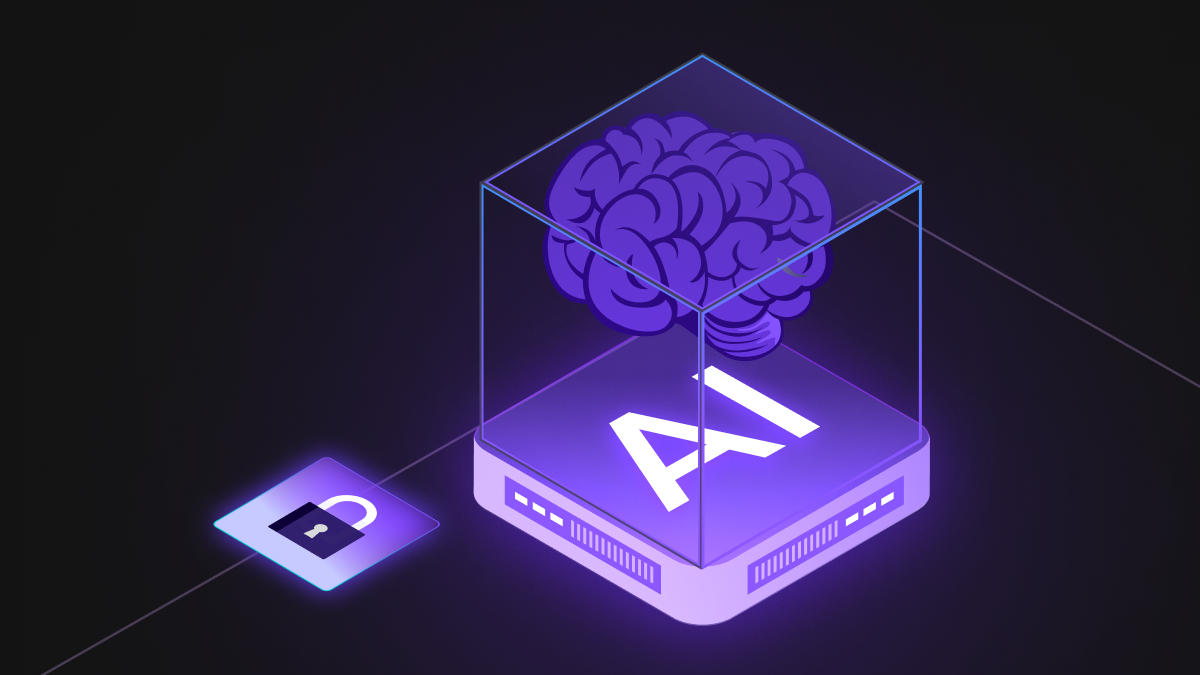
Confidential AI runs models inside hardware-protected trusted execution environments (TEEs), which are physically isolated spaces that even the underlying system administrators can't inspect. Inside these environments:
- Model weights are protected while the model is running
- Prompts and outputs remain shielded from outside view
- Access is verified cryptographically
This turns AI deployment from a leap of faith into something measurable and provable. And there’s no avoiding it.
Markets tend to move toward solutions that make things easier and create new revenue streams, and runtime protection does both. Once model owners can confidently deploy their weights into third-party environments, entirely new markets open up.
AI can be adopted in regulated industries that require private, on-premise deployments. Multinational companies can operate across sovereign markets with local data-hosting requirements.
At that point, Confidential AI is more than a niche security feature. It’s literally a commercial enabler that can scale fast.
The Future of AI Distribution Depends on Trust
The model owners who solve this stand to gain much more than stronger security. They set themselves up to encourage faster enterprise adoption, broader geographic reach, new monetization models, stronger partner ecosystems, and greater trust with customers who might be risk-conscious.
Meanwhile, model owners that can’t solve deployment trust will remain confined to narrower delivery models while competitors expand. And that gap will widen faster than expected. As we see it, the next stage of AI growth won't be won by whoever builds the smartest model. It will also go to those who can safely and flexibly distribute valuable models at scale.
The missing piece has been protecting model weights when they're most exposed. Fortanix makes that possible with Confidential AI, combining Confidential Computing, attestation and policy-driven key management to keep model IP and sensitive data protected in verified environments.
The direction is clear: Enterprises need private deployments. Model owners need to protect their most valuable assets. Infrastructure providers need a trust model that holds up under scrutiny. Confidential AI satisfies all three, serving as the foundation that any serious AI deployment strategy needs.
This isn't a possibility on the horizon. It's the next inevitability.